The Ex Lottery and Eva Kaminsky Reviews Recent
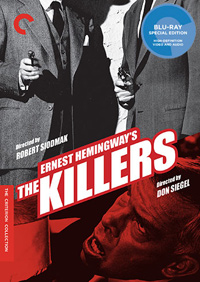 Criterion digitally restores this earlier release, a combination offering of Robert Siodmak'due south 1946 motion-picture show noir masterpiece The Killers paired with Don Siegel's retro 1964 remake. Famed adaptations of Ernest Hemingway'southward short story, both filmmakers take liberties with the original fabric to create aggressively dissimilar products. Siodmak's version is not but the German ex-pat's indelible masterpiece, information technology's a definite cornerstone of archetype American picture noir. Though Siegel's 60s rehash is considered tacky pastiche of the era, information technology's savage, hard boiled B-form pulp, notable for its own significant instances.
Siodmak's version arrived during a golden era of noir, premiering a year after WWII officially ended, with cinematic masculine representation on the eve of an overhaul as method acting would soon reign supreme. Hemingway'due south spare story gets a face life from Anthony Veiller (The Stranger; Night of the Iguana), using the murder as a jumping off signal into a mystery revealed in flashback, fleshed out with tropes synonymous with noir. The film would catapult stars Burt Lancaster and Ava Gardner, the former in his screen debut, previously an acrobatic performer in the circus and prior to his glory days as a dashing matinee idol headlining various feats of one-notation masculine bravado. The latter had floated around in uncredited and supporting roles for several years before appearing here, in a role that would be representative of the femme fatale.
2 shine talking hitting men (William Conrad and Charles McGraw) alight in a sandwich shop, commandeering it from the owner to prevarication in wait for their target, an ex-boxer known as The Swede (Lancaster). He doesn't bear witness, but Nick Adams (Phil Dark-brown equally a grapheme often featured in Hemingway's writing) flies to warn the man, who happens to exist his co-worker at the local automotive repair shop, leading the killers directly to their target. The resigned Ole 'the Swede' Andreson accepts his fate, failing to attempt to escape. Life insurance investigator Phil Reardon (Edmund O'Brien) is tasked with finding the human being's beneficiary, and begins to unravel a history of crime leading to Andreson's assassination. With the assistance of a police lieutenant (Sam Levene), Reardon tracks down associates involved in a robbery, including Big Jim Colfax (Albert Dekker), and his good time gal, Kitty Collins (Gardner).
For the 1964 version, Siegel turns to the world of race-auto driving and tells the tale from the perspective of the killers (Lee Marvin and Clu Gulager). Stumbling upon their target, defamed driver Johnny North (John Cassavetes), now teaching at a schoolhouse for the blind, they wonder why their victim makes no try to run. In an endeavour to observe out why, they practise their own investigating, and are lead to North'southward ex-flame, Sheila Farr (Angie Dickinson), who roped North into a robbery orchestrated by her beau, Jack Browning (Ronald Reagan).
Information technology seems impossible to extract Hemingway's original text from the tone of noir, and Siodmak's version is clearly the more than noteworthy endeavor. Interestingly, Siegel's version was meant to be the first fabricated-for-television feature, but information technology was deemed also violent, particularly because the cultural climate of the time, following the bump-off of JFK, an event which actually halted product.
Siegel opens with the killers terrorizing blind folks (the start being a secretary played by Virginia Christine, a character actress who appeared in the original as an early love involvement of Lancaster's character), and the vehement and aberrant misogyny goes on from in that location, especially considering Dickinson'southward graphic symbol is more than of an accessory than a character with bodily agency, culminating in a cruel punch to the face at the hands of Gulager'southward boyish psychopath.
Marvin is effectively commanding in an early lead role, somehow immune to the garishness of the farcical sets and tacky backdrops, elements swallowing Cassavetes and any intensity he can muster (an early flirtatious sequence with Dickinson finds them racing confronting i another in a courting ritual nosotros'll surely continue to come across recycled, though the loopiness here somehow recalls a water bound instance between Will Smith and Eva Mendes in 2005'due south Hitch).
In the years to follow, Marvin would become an Oscar winner (Cat Ballou) and eclipse his persona here with a more than memorable man of barbarous mystery in John Boorman's Bespeak Blank (1967). Of course, Siegel's greatest accidental coup would be the casting of Ronald Reagan as the bad guy, the function previously inhabited by graphic symbol histrion Albert Dekker. Not only was information technology Reagan'southward last film before inbound the political arena, it was his only villainous graphic symbol (purportedly, he hated the role). It's a fascinating perfect storm considering his eventual poisonous, if economically celebrated, ascension as the eventual US President.
Disc Review:
In that location's much to adore in Criterion's high-definition digital restoration of both titles, specifically with Siodmak's, featuring DoP Elwood Bredell'south framing (who was non known for noir, but would only lens seven more features including Michael Curtiz'southward The Unsuspected), and Miklos Rozsa'southward defining score, nowadays only when the actual killers are on screen (it would late be used in the television series "Dragnet"). It's a title hard to vanquish, especially considering the youthful beauty of Lancaster and Gardner, whose afterwards counterparts, Cassavetes and Dickinson, do not trounce them.
As evocative as Siodmak's version feels, Siegel's zippy remake feels like a tacky, cardboard bauble with jagged edges, delivering shocking paper cuts in its grim and sometimes surprisingly vehement sequences. It's a gaudy remake, and Richard Rawlings' cinematography seems calibrated for television, prizing snazzy, unnecessary zooms, and oftentimes featuring ungodly lighting on ill-prepared sets spliced with footage of actual race cars.
1946 Supplements:
Andrei Tarkovsky's Killers:
Peradventure the most notable extra characteristic is this 1956 short motion picture co-directed past Alexander Gordon, Marika Beiku and Andrei Tarkovsky at the All-Spousal relationship State Plant of Cinematography. Standing as Tarkoksy's first moving picture, the xix minute short if divided into three parts, one of the very get-go adaptations students at VGIK were allowed to base projects on foreign material. The roles were played past students and information technology is a striking short.
Kaminsky Interview:
A 2002 Criterion interview with screenwriter Stuart Kaminsky is about seventeen minutes, and the give-and-take includes reference to how the producers wanted Don Siegel to originally direct the film, merely were unable to attain him due to Siegel's contractual obligations.
Stacy Keach Reading:
Actor Stacy Keach reads aloud Hemingway's original story, originally recorded for the Simon & Schuster audiobook Ernest Hemingway: The Short Stories. An intriguing extra, especially if you lot've neglected to read the source cloth.
Screen Directors' Playhouse:
Burt Lancaster, Shelley Winters, Tony Barrett, and William Conrad were office of the original radio broadcast of The Killers, which aired on June 5, 1948 every bit an episode of the series Screen Directors' Playhouse. The plan is about one-half an 60 minutes in length.
1964 Supplements:
Reflections with Clu Gulager:
This 2002 Criterion interview with Gulager, filmed by the role player'south sons in Los Angeles, is 18 minutes in length. The actor discusses his reasons for finding the film to be 'pregnant.'
A Siegel Film:
An extract from Siegel's autobiography concerning The Killers is read aloud past actor/director Hampton Fancher. Almost 20 minutes in length, information technology'south an innovative glance at Siegel's investment in the material.
Terminal Thoughts:
With the original film version frequently referred to as the Denizen Kane of film noir, The Killers is required viewing. Siodmak's picture show would come up to deftly approximate our ingrained notions of the glace genre, and as presented in this stylish philharmonic with its unnecessary but ultimately notable derivative version simply proves to ostend its legacy.
1946 Picture: ★★★★/☆☆☆☆☆
1964 Film: ★★½/☆☆☆☆☆
Disc: ★★★★/☆☆☆☆☆
Source: https://www.ioncinema.com/news/disc-reviews/criterion-collection-the-killers-blu-ray-review
0 Response to "The Ex Lottery and Eva Kaminsky Reviews Recent"
Post a Comment